
Dyndrite Awards $10,000 Innovation Prize to University of Waterloo Researchers in Inaugural Student Competition
Winning submission demonstrates the potential of programmable processing to address porosity and process-induced defects that have long challenged LPBF reliability and repeatability
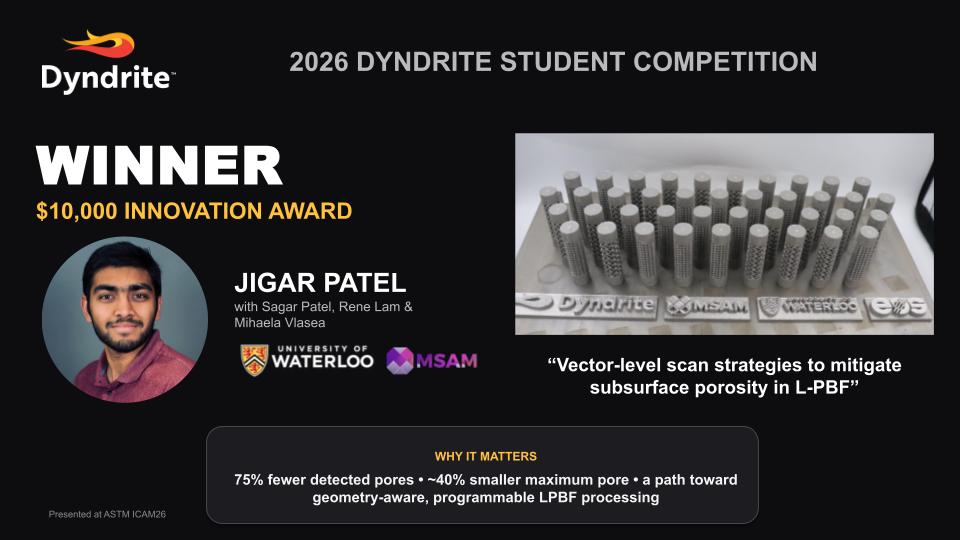
ORLANDO, Fla., October 1, 2026 – Dyndrite, a provider of next-generation industrial software for additive manufacturing, today announced Jigar Patel of the University of Waterloo as the winner of the inaugural Dyndrite Student Competition and recipient of the competition’s $10,000 Innovation Award. The award was presented during the ASTM International Conference on Advanced Manufacturing (ICAM 2026) in Orlando, Florida.
Patel was recognized for his work, “Vector-level scan strategies to mitigate subsurface porosity in L-PBF,” conducted with Sagar Patel, Rene Lam, and Associate Professor Mihaela Vlasea at the University of Waterloo’s Multi-Scale Additive Manufacturing (MSAM) Lab.
Using Dyndrite LPBF Pro, the research demonstrated 75% fewer detected pores and an approximately 40% reduction in maximum pore size, highlighting the potential of vector-level scan strategy control to reduce subsurface defects and enable more geometry-aware, programmable LPBF processing.
“From a hardware perspective, metal additive manufacturing systems have exceptional capabilities today. However, we are often bottlenecked by the software tools available to improve build quality, performance, and productivity. It’s the equivalent of having a racecar but never being able to get out of second gear,” said Mihaela Vlasea, Associate Professor at the University of Waterloo. “As researchers, we continuously push the boundaries of discovery while working to translate disruptive outcomes into industry-ready, scalable solutions. That led us to use Dyndrite software across multiple LPBF machines to unlock more of the technological potential hidden under the hood.”
Moving Beyond Detecting Defects to Engineering Against Them
Porosity remains a fundamental challenge in laser powder bed fusion (LPBF). Pores are not simply microscopic imperfections. Their size, location, shape, and concentration can create stress concentrations and crack-initiation sites that affect fatigue life, mechanical performance, and part-to-part consistency.
Patel’s research explores a different approach: rather than simply detecting defects after a part has been produced, use programmable, vector-level control of the LPBF process to actively engineer against their formation.
“We chose to focus on subsurface porosity because it remains a persistent challenge limiting the reliability and broader adoption of LPBF,” said Jigar Patel. “What excited us was the opportunity to move beyond identifying defects after they occur and instead use vector-level control to influence where and how they form. By demonstrating that vector-level scan strategies can significantly reduce both the number and size of pores, we’re showing a path toward greater control of the LPBF process and, ultimately, more predictable, reliable, and scalable manufacturing.”
“While the root causes of longstanding LPBF challenges, including fatigue performance, surface roughness, residual stress, and porosity, are increasingly well understood, the relatively simplistic scanning strategies available in conventional software can make them difficult to address,” said Sagar Patel, Postdoctoral Research Associate at the Multi-Scale Additive Manufacturing Lab, University of Waterloo. “Dyndrite puts many more levers in the hands of LPBF practitioners like us, creating new opportunities to improve mechanical performance while, more importantly, expanding design freedom and challenging the traditional limits of what can be manufactured with LPBF. Dyndrite has already enabled us to translate our wacky ideas for vector-level beam path control into reality across Renishaw, Nikon SLM Solutions, and EOS LPBF systems with ease.”
Giving the Next Generation New Tools to Rethink Additive Manufacturing
The Dyndrite Student Competition was established to provide university students and researchers with access to advanced, programmable additive manufacturing software and encourage them to explore new approaches to materials, process development, scan strategies, qualification, and production.
Rather than limiting researchers to predefined processing strategies available through conventional machine software, Dyndrite LPBF Pro provides programmatic control over how geometry is identified, segmented, and processed, including the ability to manipulate laser parameters and toolpaths at the vector level.
“This is exactly the kind of work we hoped to inspire when we created the Dyndrite Student Competition,” said Harshil Goel, founder and CEO of Dyndrite. “We give students free access to Dyndrite LPBF Pro, our programmable software foundation, and challenge them to rethink what is possible when they have control over the manufacturing process. Jigar and the Waterloo team took that opportunity and demonstrated how software can be used to attack a fundamental LPBF challenge at the process level.”
The award was presented at ICAM 2026 with representatives from the additive manufacturing community, including Mohsen Seifi of ASTM International, Harshil Goel of Dyndrite, and Nima Shamsaei of Auburn University.
To learn more about the Waterloo team’s research, visit: https://msam.uwaterloo.ca/publications/
Students interested in free access to Dyndrite LPBF Pro can request it at: https://www.dyndrite.com/lpbf-student-landing-page
About Dyndrite
Dyndrite provides a GPU-accelerated software foundation for digital manufacturing. Its technology gives engineers programmatic control over geometry, process parameters, toolpaths, and manufacturing data, enabling new approaches to additive manufacturing process development, qualification, automation, and serial production.
Dyndrite’s mission is to empower engineers to transform how manufacturing processes are developed and controlled through powerful, programmable software.
Dyndrite is a trademark of Dyndrite Corporation. All other trademarks and registered trademarks previously cited are hereby recognized and acknowledged.