
Dyndrite and Xact Metal Deliver a Commercial First in LPBF: Complete Toolpath Control
Native, scan card level control for arcs and other commands including gives customers the unparalleled ability to optimize LPBF builds.
SEATTLE, Wa. and STATECOLLEGE, Pa. – November 11, 2026 –Dyndrite™ and Xact Metal today announced the world's first truly available full G-code toolpath integration for a laser powder bed fusion (LPBF) OEM. XactMetal has opened full-level control access to the scanning systems in its printers. Dyndrite LPBF Pro can now command native arcs and other scan commands directly, instead of reducing every curve to a chain of straight-line vectors.
Why straight lines fall short
Today's LPBF toolpaths approximate every curve with short straight chords. Each chord adds geometric error, and every corner forces the scan mirrors to slow down, spiking line energy and heat. Holding 1 µm accuracy on a10 mm-radius circle takes about 222 vectors; a native arc takes one.
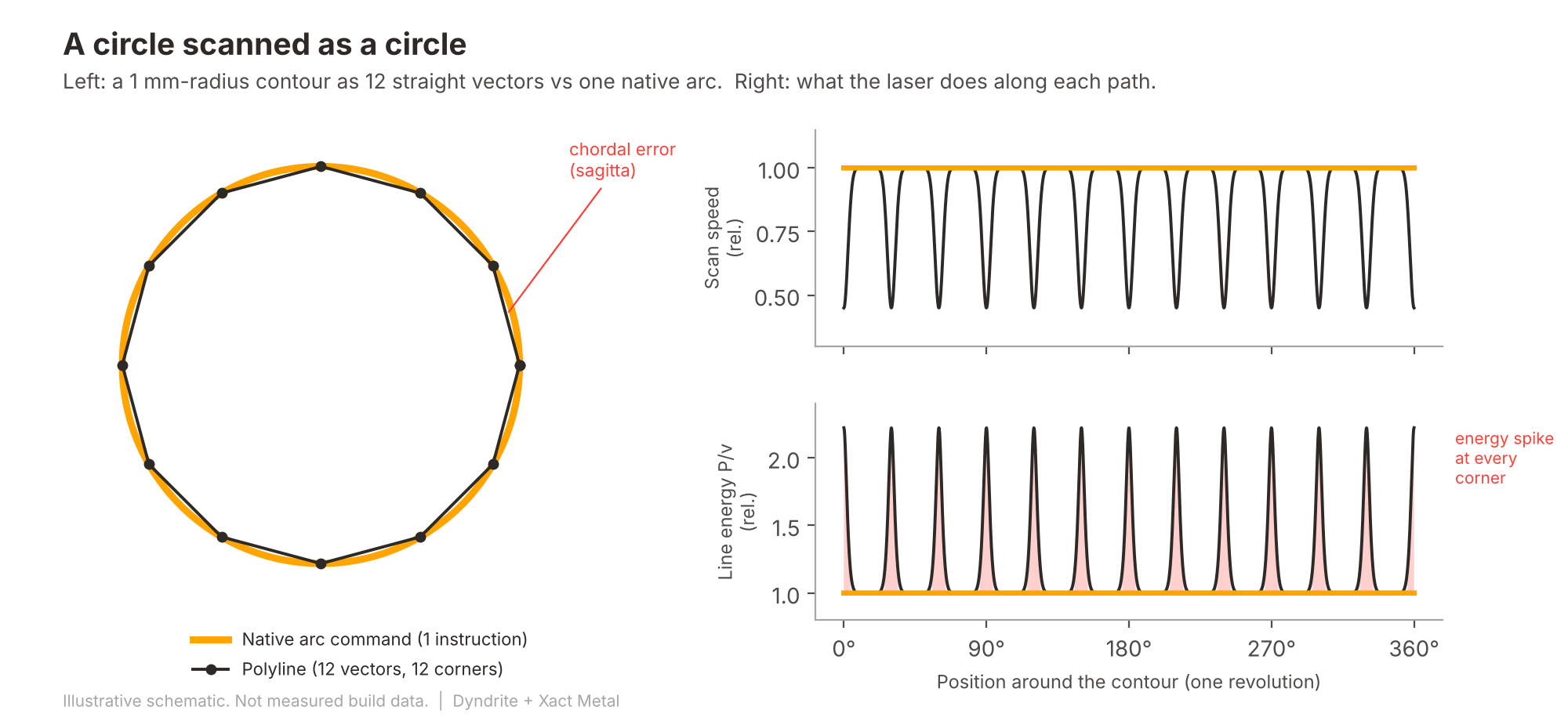
With native arcs and other scan card commands on Xact Metal printers Dyndrite users can enable:
Advanced Toolpath Control:
• Beyond linear moves – arcs, Bezier curves, wobble, and more…
• Delay and Skywriting settings – per vector mark, jump, poly delaysettings
• More laser commands – dynamic set point, pulsing, and more…
Benefits:
• Reduced file size and print times
• Reduced wear and tear on the optical subsystem
• Improved surface finish and ability to consistently print lowangle geometries
• Ability to print applications previously deemed “unweldable” inLPBF
• Reduced porosity and defects
Taming heat build-up
Heat builds up wherever the laser returns before the last pass has cooled. Full scan control gives engineers new ways to manage it. Here are two simple examples:
1. Thin circular walls. Fill a ring with straight hatch lines and the lines at its sides only cross the 1 mm wall. They are so short that the laser is back on the neighbouring line before the metal has cooled, so the sides of the ring overheat. Hatching with arcs that follow the wall instead makes every pass a full lap of the ring, spreading heat evenly. In the example below, 150 short straight lines become 8 continuous arcs.
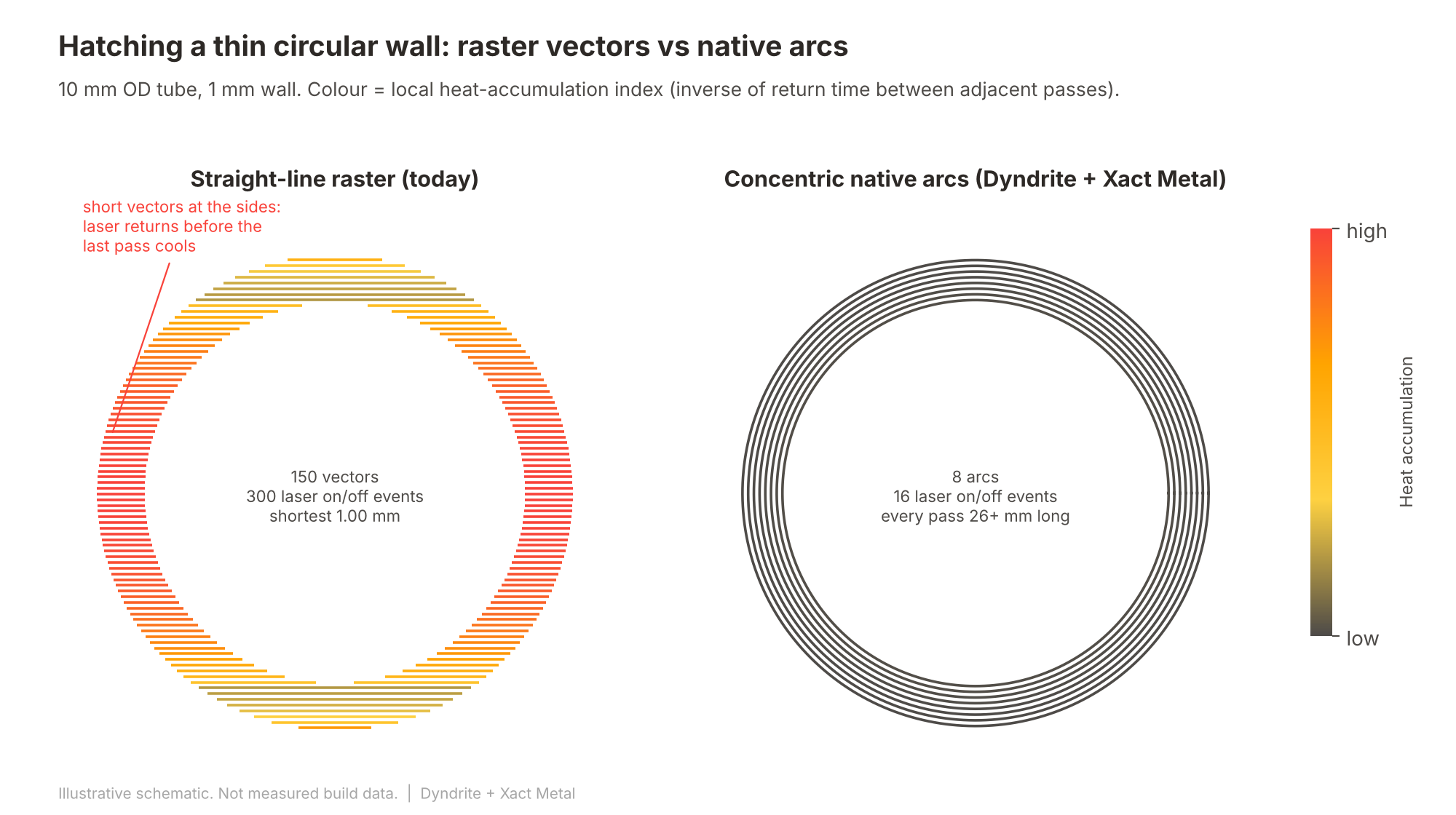
Note: This is just a capability illustration, NOT a recommendation. Concentric arc hatching is one example of what native arcs make possible. Of course, any hatch pattern used must ultimately deliver the metallurgical strength the part needs for its form, fit and function, and must be validated for the application.
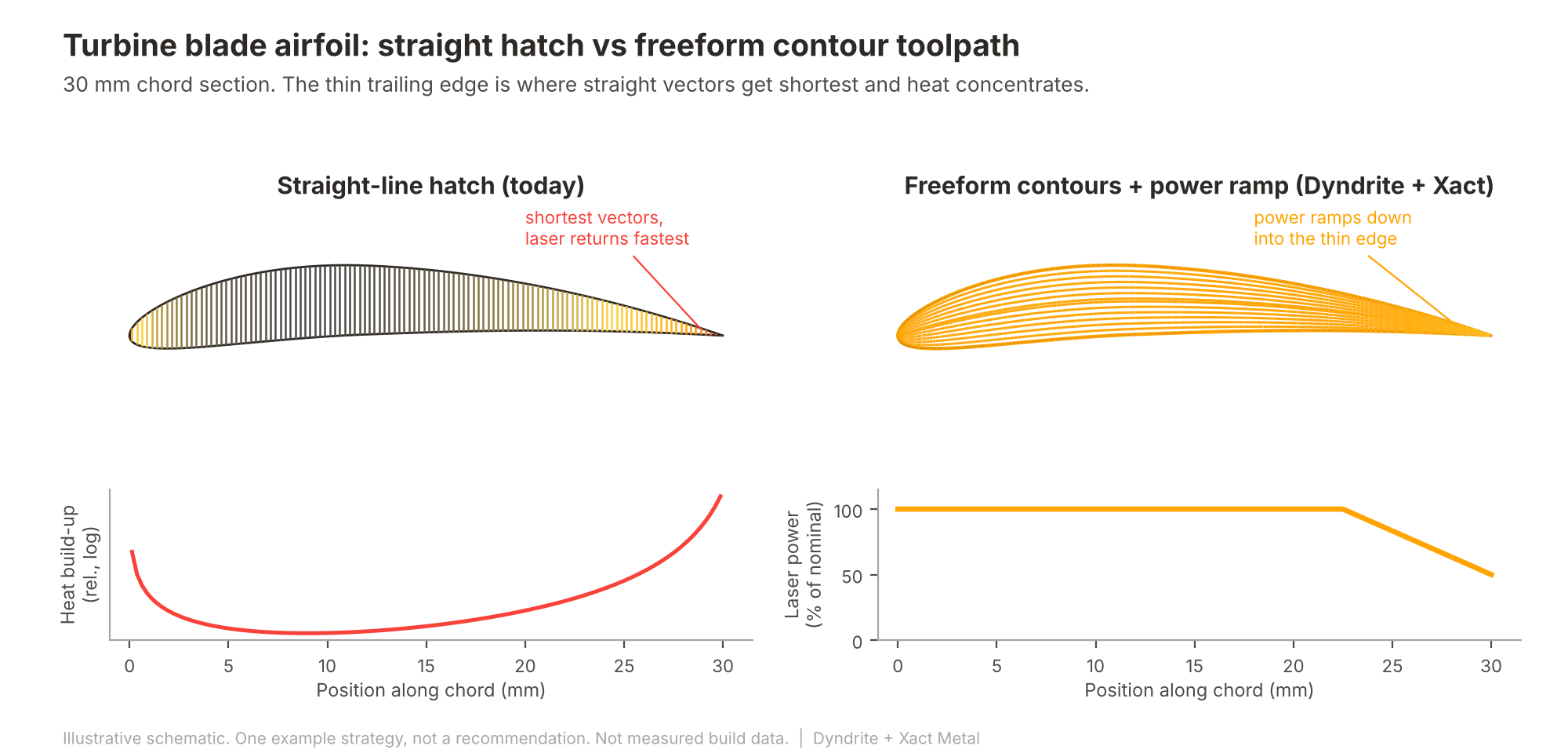
2. Turbine blade airfoils. Blades taper to a thin trailing edge where straight hatching can concentrate heat. Dyndrite LPBF Pro's parametric hatching defines passes from the part's own geometry, following its curvature and ramping power down as the section thins. On Xact Metal, those paths can run as smooth native curves.
What the partners say
“This is a hugely important step for LPBF,” said Harshil Goel, Founder and CEO, Dyndrite. “For too long the industry has had to cope with inadequate toolpath definitions. That's surprising, because scan cards have been far more capable than OEMs have made available for years. It's great to see an OEM step up and trust their users enough to provide total access to the print platform they have invested in.”
“The technical challenges of working directly with a scan card have been known to us for a while,” said Steve Walton, Head of Product, Dyndrite. “We just needed someone to open up their system to what Dyndrite makes possible. Xact Metal has been progressive in doing exactly that.”
“I’ve been a fan of Dyndrite for many years, and I couldn’t be more excited to open our platform to Harshil and his team,” said Juan Mario Gomez, CEO of Xact Metal. “Since introducing our first printer, we’ve wanted to give customers complete freedom over how they program their builds and not be restricted by the systems we control. The partnership gives Dyndrite LPBF Pro complete control over the Xact Metal print platform, allowing customers to produce build files with unprecedented freedom in every aspect of the toolpath to improve part quality and get the most value from their investment.”
“We’re opening our platform because we believe customers should have thefreedom to get everything possible out of their machines,” said Gomez. “Theintegration gives Dyndrite LPBF Pro full laser and scan card control acrossXact Metal’s print systems. Customers can program every aspect of the toolpath,including stir welding, power ramping, and parametric curves—a capability webelieve is a commercial industry first in the LPBF industry. This accessexpands the possibilities for process development, enabling users to tailorprinting strategies to their parts, materials, and production requirements.Together with Dyndrite we’re giving customers the tools to push the boundariesof laser powder bed fusion.”
Paul Hollowaty, Xact Sr. Sales Manager, comment, “For years I had been watching how Dyndrite was extending the capabilities of various printer platforms, yet none of them ever truly opened up their system for complete control. One of the reasons I joined Xact is that Juan Mario and his leadership team recognized the benefits of an open system and were eager to engage in a partnership with Dyndrite to make it happen. Our customers will benefit immensely.”
Availability
Native arc and full scan-command toolpathing is available now through Dyndrite LPBF Pro on the Xact Metal XM200G and XM200G µHD, with the XM300G to follow. To get access, contact Dyndrite at dyndrite.com/contact or Xact Metal and its sales partners at xactmetal.com/contact.
See it live in the Xact Metal Booth at Formnext 2026, Frankfurt, November 17–20. HALL 12.0, BOOTH C89
About Dyndrite
Dyndrite Corporation is composed of mathematicians, software engineers, designers, mechanical engineers, and believers in the transformative power of digital manufacturing. Through new geometry and computing technologies, we aim to unlock the promise of emerging fabrication technologies, such as additive manufacturing (AM) within production-oriented environments, across numerous industries, including aerospace, automotive, medical, energy, consumer goods, and contract manufacturers. For more information visit: https://www.dyndrite.com
About Xact Metal
Founded in 2017 and headquartered in State College, Pennsylvania, Xact Metal makes affordable metal laser powder bed fusion printers that bring high-quality metal 3D printing to small and medium-sized manufacturers, research institutions and educators, supported worldwide by local sales partners. For more information, visit xactmetal.com.
Dyndrite is a trademark of Dyndrite Corporation. All other trademarks and registered trademarks previously cited are hereby recognized and acknowledged.